
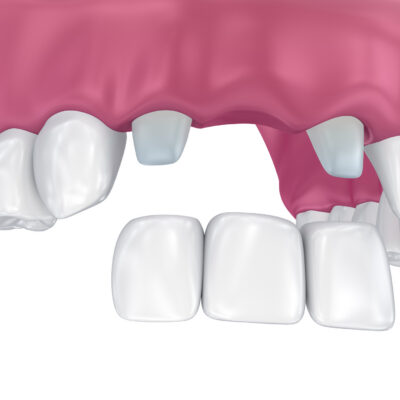
Dental bridges are a common way to replace missing teeth, but they are not designed to last forever. Many bridges begin to show problems after 10 to 15 years, often because the supporting teeth underneath develop decay, gum disease, or cracks. When a bridge fails, dental implants are often the best long-term solution because they stand on their own and do not rely on neighboring teeth for support. At Precision Periodontal and Implant Center, we help Redondo Beach patients evaluate failing bridges and plan a more permanent way to restore their smile.
Why Do Dental Bridges Fail?
A traditional bridge uses the teeth on either side of a gap as anchors. Those teeth are shaped down and covered with crowns, which then hold a false tooth in the middle. Over time, this design can create weak points.
Common reasons bridges fail include:
- Decay under the crowns, which can develop unnoticed at the edges
- Gum disease around the anchor teeth, making them loose
- Cracked or fractured anchor teeth from years of chewing pressure
- Cement breakdown, allowing bacteria to leak underneath
- Bone loss under the false tooth, creating a visible gap at the gumline
Because the bridge is connected as one unit, a problem with a single anchor tooth can put the entire restoration at risk.
What Are the Warning Signs of a Failing Bridge?
Pay attention if you notice any of the following:
- The bridge feels loose or moves when you chew
- A bad taste or odor that does not go away with brushing
- Sensitivity or pain in the anchor teeth
- Swollen, bleeding, or receding gums around the bridge
- Food frequently getting trapped under the false tooth
- A dark line or space appearing near the gumline
Catching these signs early can help preserve as much healthy bone and tooth structure as possible.
Can a Failing Bridge Simply Be Replaced?
Sometimes a new bridge is an option, but only if the anchor teeth are still healthy and strong. In many cases, those teeth have already been weakened by decay or cracks, and placing another bridge on them would only repeat the cycle.
This is where dental implants offer a meaningful advantage.
Why Are Implants a More Permanent Solution?
An implant replaces the missing tooth root and is anchored directly in the jawbone. That means:
- No dependence on neighboring teeth, so healthy teeth stay untouched
- Bone stimulation that helps prevent further shrinking of the jaw
- Easier cleaning, since each implant can be brushed and flossed individually
- Long-term durability, with many implants lasting decades with proper care
- A natural look and feel that blends with your surrounding teeth
If the anchor teeth cannot be saved, implants can replace them as well, restoring the area with a stable, independent foundation.
What Does the Transition From a Bridge to Implants Look Like?
Every case is different, but the process typically includes:
- Removing the bridge and evaluating the anchor teeth and bone
- Extracting any teeth that cannot be restored
- Rebuilding bone with advanced bone grafting when needed
- Placing the implant or implants using 3D-guided planning
- Attaching a custom crown or restoration once healing is complete
Temporary teeth can often be provided during treatment so you are never without a smile. You can learn more about each step on our implant placement page.
Do Not Wait Until the Bridge Comes Out
A failing bridge rarely improves on its own. The longer decay or infection is left untreated, the more bone and tooth structure can be lost, which may make future treatment more complex.
Schedule a Consultation for Your Failing Bridge Near Redondo Beach
If your bridge feels loose, uncomfortable, or simply is not what it used to be, the team at Precision Periodontal and Implant Center can evaluate your options and recommend a lasting solution. Call 310-708-3938 today to schedule your consultation.