
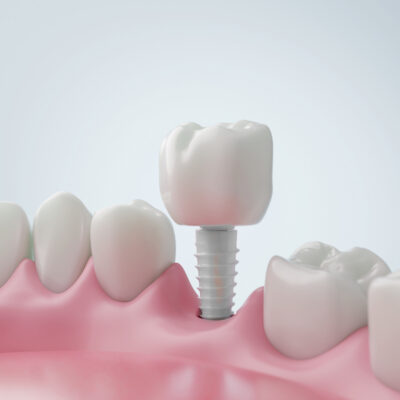
When a tooth is cracked, badly decayed, loose, or has already had several treatments, you may face a tough decision: should you try to save it, or remove it and replace it with a dental implant? There’s no single right answer for everyone. In general, a natural tooth is worth saving when it has a good long-term outlook. When a tooth’s prognosis is poor, a dental implant is often the more predictable and lasting choice.
At Precision Periodontal and Implant Center, we help patients weigh both options honestly. As a practice focused on periodontics and dental implants, we look closely at the tooth, the gums, and the supporting bone before making any recommendation.
Why Saving Your Natural Tooth Is Often the First Choice
Natural teeth have advantages that are hard to match. The ligament around a tooth root acts as a natural shock absorber and gives you subtle feedback when you chew. Keeping your own tooth also avoids surgery to place an implant and preserves the natural gum and bone contours around it.
When a tooth has a solid foundation, treatments such as a root canal, a crown, gum disease treatment, or crown lengthening can keep it working for many years. Crown lengthening, for example, can expose more healthy tooth structure so a tooth broken near the gumline can be restored properly. You can learn more on our crown lengthening and gingival contouring page.
When a Dental Implant May Be the Better Option
Sometimes, saving a tooth means investing time and money into a treatment with a low chance of lasting success. In those cases, an implant may be the smarter long-term choice. Situations where an implant is often recommended include:
- A vertical root fracture: Cracks that run down the root usually can’t be repaired.
- Decay that extends far below the gumline: If too little healthy tooth remains, a crown may not hold.
- Severe bone loss from gum disease: A tooth that has lost most of its supporting bone may stay loose even after treatment.
- Repeated failed treatments: A tooth that has had multiple root canals or crowns may have little structure left.
- Recurring infections: Ongoing infection can damage the surrounding bone over time.
Key Questions to Ask About Your Tooth
To decide between saving or replacing a tooth, we consider several factors:
How Much Healthy Tooth Structure Remains?
A tooth needs enough sound structure above and below the gumline to support a lasting restoration. If most of the tooth is gone, even the best crown may fail.
How Healthy Are the Gums and Bone?
The gums and bone are the foundation for any tooth. If gum disease has caused significant bone loss, the tooth may not be stable. On the other hand, if the gums can be treated successfully, the tooth may be saved.
What Is the Long-Term Outlook?
We look beyond the next few months. A treatment that saves a tooth for a year or two may not be the best investment if an implant could last decades.
How Does This Tooth Affect Your Overall Plan?
A single tooth is part of a bigger picture. If a tooth is supporting a bridge, or if neighboring teeth also have problems, the best plan may involve more than one tooth.
What Are Your Goals?
Your preferences matter. Some patients want to keep every natural tooth as long as possible. Others prefer the predictability of an implant. We’ll explain the pros and cons of each option so you can make an informed decision.
The Risk of Waiting Too Long
One mistake we often see is holding on to a failing tooth for too long. When a tooth with a poor prognosis stays in place, ongoing infection or inflammation can destroy the surrounding bone. That bone is exactly what an implant needs for support.
Waiting can mean that, when the tooth finally has to come out, bone grafting is needed before an implant can be placed. Making a decision while healthy bone is still present often leads to a simpler, faster treatment and, in some cases, allows for an immediate implant on the same day the tooth is removed.
How Advanced Imaging Guides the Decision
At Precision Periodontal and Implant Center, we use 3D imaging to see the tooth root, surrounding bone, and nearby anatomy in detail. This lets us spot hidden cracks, measure bone levels, and evaluate infection more accurately than traditional X-rays alone. These details help us give you a clear, honest assessment of whether your tooth can be saved.
What to Expect If an Implant Is Recommended
If replacing the tooth is the best option, the process is carefully planned for comfort and long-term success. Depending on your situation, the tooth may be removed and an implant placed at the same time, or the site may be allowed to heal first. Bone grafting may be recommended to preserve the area.
Once the implant fuses with your jawbone, a custom crown is attached to restore your bite and smile. With proper care, a dental implant can last decades. You can read more about the process on our implant placement page.
Working With Your Dentist
Dr. Ivanov works closely with general dentists, endodontists, and other specialists. If your tooth can be saved, we’ll coordinate with your dentist to make that happen. If an implant is the better option, we’ll create a plan that fits seamlessly into your overall dental care.
Get a Clear Answer About Your Tooth in Torrance
If you’ve been told a tooth may need to come out, or you’re unsure whether another treatment is worth it, a second opinion from a periodontist can give you clarity. Precision Periodontal and Implant Center serves patients throughout the South Bay, including Torrance, with honest guidance and advanced care.
Call 310-708-3938 today to schedule your consultation with Precision Periodontal and Implant Center and find out whether saving your tooth or replacing it with an implant is the right choice for you.