
Some people grow up with a gap that was never caused by decay, injury, or gum disease. Instead, the adult tooth simply never formed. This condition is called congenitally missing teeth, or hypodontia, and it’s more common than many people realize. You may have been told as a child that a baby tooth would “stay in for a while” or that you’d need a solution once you were older.
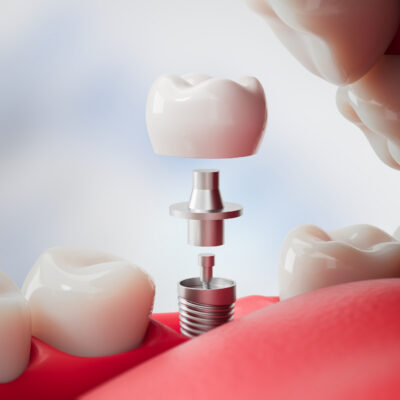
For many teens and adults, dental implants are the most natural, long-lasting way to replace teeth that never developed. At Precision Periodontal and Implant Center, we help patients and families understand when implants are possible, what preparation may be needed, and how to plan for a result that looks and feels natural.
Which Teeth Are Most Often Missing?
Aside from wisdom teeth, the teeth most commonly missing from birth are the upper lateral incisors, the small teeth on either side of the two front teeth, and the lower second premolars, located just in front of the molars. Some people are missing just one tooth, while others are missing several.
Missing lateral incisors are especially noticeable because they sit in the smile zone. Many patients feel self-conscious about the gap or about narrow, uneven spacing in their front teeth.
What Happens When an Adult Tooth Never Forms
When an adult tooth doesn’t develop, one of two things usually happens. In some cases, the baby tooth stays in place well into adulthood. These baby teeth can last for years, but their roots are short and often weaken over time, eventually leaving a gap. In other cases, the baby tooth falls out and there’s nothing underneath to replace it.
Either way, the area can change over time. Neighboring teeth may drift into the space, and the jawbone where a tooth never grew is often thinner or narrower than normal. These factors are important to consider when planning an implant.
When Can Dental Implants Be Placed?
Timing matters. Dental implants are anchored in the jawbone and don’t move the way natural teeth do as the jaw grows. If an implant is placed before jaw growth is complete, it can end up looking shorter or out of line with the surrounding teeth as the face continues to develop.
For this reason, implants are typically placed once jaw growth has finished, usually in the late teens or early twenties. Every patient develops on their own timeline, so we evaluate growth carefully before recommending treatment.
Holding the Space Until Implants Are Possible
For younger patients, the goal is to protect and maintain the space until an implant can be placed. Options may include:
- Orthodontic treatment to create the ideal amount of space for a future implant
- A retainer with a replacement tooth attached to fill the gap temporarily
- A bonded temporary bridge that attaches to the backs of neighboring teeth without heavily altering them
Coordinating with your orthodontist is especially important. The space needs to be wide enough at both the crown and the root level so the implant fits properly between neighboring teeth.
Why Dental Implants Are an Excellent Long-Term Solution
Implants offer several advantages for patients with congenitally missing teeth:
- No impact on healthy teeth: A traditional bridge requires reshaping the neighboring teeth, which are often perfectly healthy in young patients. Implants stand on their own.
- Bone preservation: Implants stimulate the jawbone, helping maintain its volume over time.
- Natural appearance: A custom crown is designed to match the shape and shade of your surrounding teeth.
- Durability: With proper care, an implant can last for decades, an important consideration for young patients with many years ahead of them.
You can learn more about how the procedure works on our implant placement page.
Building Up Bone and Gum Tissue
Because a tooth never grew in the area, the jawbone may not be wide or tall enough to support an implant. This is especially common in the narrow space of a missing lateral incisor. In these cases, bone grafting can rebuild the area so the implant has a strong, stable foundation. Learn more on our advanced bone grafting page.
The gums matter, too. In the front of the mouth, thin gum tissue can let a gray shadow show through or lead to recession over time. Soft tissue grafting can thicken the gums for a more natural, lasting result. As a periodontist, Dr. Ivanov focuses on both bone and gum health so your implant looks great and stays healthy.
Planning With Precision
Every congenitally missing tooth case is unique. At Precision Periodontal and Implant Center, we use 3D imaging to measure bone volume, check the position of neighboring roots, and plan the exact placement of the implant. In many cases, guided surgical techniques help us place the implant precisely where it needs to be for both function and appearance.
We also work closely with your general dentist and orthodontist. This team approach ensures that spacing, implant placement, and the final crown all work together.
What About Patients Who Kept Their Baby Teeth?
If you’re an adult who still has a baby tooth in place of a missing adult tooth, you don’t need to remove it right away if it’s healthy and stable. However, it’s wise to have it evaluated. If the baby tooth is loose, has a short root, or is starting to fail, planning ahead allows us to remove it and place an implant at the right time, sometimes even on the same day.
Comfort and Support at Every Step
Many younger patients and their parents feel nervous about implant surgery. We take time to explain each step and answer every question. Local anesthesia keeps the area comfortable, and sedation options are available for anxious patients. Most people are surprised by how manageable the process feels.
Replace Missing Teeth With Confidence in Hawthorne
If you or your child was born without certain adult teeth, you don’t have to live with gaps or temporary fixes forever. Precision Periodontal and Implant Center is conveniently located near Hawthorne and ready to help you plan a lasting, natural-looking solution.
Call 310-708-3938 today to schedule a consultation with Precision Periodontal and Implant Center and find out whether dental implants are right for you or your teen.